I hope that we're finally moving past the "a good pianist is hard to find" lament, because there are many fine pianists out there — you simply might not have heard of them. Take for example Chinese-born Chu-Fang Huang, whose levelheaded but expressive playing deserves note.
I heard Ms. Huang perform a program that included Haydn, Chopin's second sonata, modern Chinese music, and Prokofiev's seventh sonata. The recital nicely showed off her music range and the pieces played upon one another in interesting ways (for example, not many would blame you for mistaking Wanghua Chu's Xingjing Fantasy for Prokofiev). Huang has an excellent command of dynamics and stakes out a sensible middle-ground when it comes to tempos. While her playing might not have Yuja Wang's flair or Jeremy Denk's meditative qualities, she never gets in the music's way. And at only 23, she's a pianist with a bright future.
My only real disappointment was not getting to the chance to interview Ms. Huang after the recital!
Well, I've been terrible about posting, but it hasn't been out of lack of
interest. In fact, I've really wanted to write reviews of three concerts (Lang
Lang, Yo-Yo Ma and Norah Jones) and several movies, but unfortunately life has
had other plans for me. Hopefully I’ll
get around to writing a bit about Lang Lang, at the very least. There's lots to be written about him, stereotypes about Asian musicians, and the current state of classical music.
This blog is here to stay and here are a few snapshots (I emphasize "snapshots" as my DSLR was taken in for repair) from a
recent trip to D.C., where I spent several hours at the Washington Zoo. Zoos are obviously controversial places and seeing a group of "feeder"
goldfish petrified in the four corners of a rather nightmarish looking aquatic
snake’s tank reminded me of this. At the
same time, though, so many people, particularly those in urban environments, are divorced from nature, at least ostensibly. The separation of 'civilization' from ‘nature’ has had terrible consequences on our environment, and without zoos, this separation would be even more pronounced.
Anyways, I hope you enjoy the pictures and please check back soon as I
promise reviews of both Cloud Atlas and
Skyfall.
I've been to a number of major zoos, but the Washington Zoo is probably my favorite.
Reboots are all the rage, and I actually enjoyed this one. I saw it in 3D because it was the only showing that a friend and I could catch, and while the the 3D did nothing for this one, the special effects were good. Andrew Garfield does a pretty good job making the Peter Parker character a little complicated without overdoing it. The villain wasn't the best, but this was fun, if forgettable.
To Rome with Love (2012)
Woody Allen
This is probably the most polarizing film of the bunch, as Woody Allen movies tend to be. Someone I know described it as "charming" and I completely agree. The four vignettes presented here (two of which are completely in Italian) are a delightful mix of comedy, satire, opera and Italian visual delight. Some people think of Allen's movies as being a bit trite, but this felt fresh with plenty to unpack. All the performances are good with Jesse Eisenberg, Roberto Benigni and Alessandro Tiberi standing out. I think Allen knew precisely what he was doing with his two most recent flicks, and it's reassuring given the large number of confused movies out there.
Norwegian Wood (2010)
Tran Anh Hung
I'd been really looking forward to seeing this one as its based on one of my favorite contemporary novels. Unfortunately, it falls quite flat, simply moving an attractive cast along a book plot; there's no real character development here. The score deserves some commenting on: I'm a big fan of Radiohead, but I've never been completely "on board" with Jonny Greenwood's avante-garde classical offerings. And while he can tap into a sound evocative of jazz greats like Eric Dolphy and Charles Mingus (or even Sun Ra), I'm not sure that ambiance works in all contexts. The guitar theme works well for the film, but some of the orchestral music becomes tedious. While this didn't really work as movie, it had enough pretty shots that get me interested in its director.
The Scent of Green Papaya (1993)
Tran Anh Hung
Which takes me to...something much more interesting! Tran Anh Hung's enormous talent is evident here in one of the visually beautiful films I've ever seen. Hung is French-Vietnamese, influenced by Ozu and Japanese cinema, and shot this film set in Vietnam on a sound stage in Boulogne, France. The movie's production raises questions about what it means to make a movie about a country one knew only in childhood. Perhaps I'll get to writing about this film in the future...
Hello! Here are some pictures from a day trip to Beacon, NY, a pleasant little town about 70 miles outside of New York. A friend and I went to check out the Dia: Beacon gallery, which wasn't my cup of tea, though there were a lot of charming shops and nice views of the river in the town itself. Two of the highlights were Play Toys & Gifts and the Cup & Saucer Tea Room.
Cool Japanese Erasers
Nya Nya
Jellyfish or Just Bubbles?
Salmon Cakes
Chicken Crepe (Delicious)
My friend and I also shared a pretty killer scone, but it was eaten too quickly for pics.
Hello! Since I've been listening to a lot of film scores recently, as well as composing some piano music, I thought I'd share some of my favorite movie music:
Midnight in Paris
(Stephane Wrembel)
I have a special place in my heart for this little film, and that's probably in no small part due to its easygoing yet heartfelt score. Woody Allen's love of jazz shines through here and Sidney Bechet "Si Tu Vois Ma Mere" has never sounded more timeless.
A Tale of Two Sisters
(Lee Byung-woo)
A classic K-Horror film, A Tale of Two Sisters takes a searing look at familial cruelty. Visually, this is my favorite film of the bunch and its main musical theme is gorgeous.
Hana-Bi
(Joe Hisaishi)
It would be possible to fill this whole list with scores by the incomparable Joe Hisaishi! This violent cop movie is visually arresting featuring artwork created by the director, "Beat" Takeshi Kitano (who also stars in the film), juxtaposed against bloody brutality. The main theme is one of Hisaishi's saddest compositions.
Amélie
(Yann Tiersen)
One of the most famous film scores of all! The arrangements aren't as intricate as Hisaishi's, but it would be hard to pass this one over.
***
Sadly, movies are one of the few places to hear new classical music that isn't atonal, though I've heard that's changing a bit. Regardless, I'd like to hear music like this get more mainstream play. What are your favorite film scores?
Last summer, I spent the month of the July in Oxford, England at Lady Margaret Hall, and between learning to punt on the Thames, reading Nabokov in the lovely gardens, and seeing/meeting so many interesting people, it was an extraordinary trip. Perhaps I'm a bit nostalgic with Wimbledon starting tomorrow, but I'd like to share a few pictures here. I'll also be uploading many more pictures from the trip to my Flickr account. Thanks for reading and enjoy!
2012 has been a disappointing year as far as movies go, but I've finally found something special in the beautiful Canadian-French film, Monsieur Lazhar.
Directed by the modest Philippe Falardeau, this film, set in Montreal, centers around Bashir Lazhar, an Algerian immigrant who begins teaching an elementary school class after its beloved teacher commits suicide. Lazhar, played by Mohamed Saïd Fellag with aplomb, is the kind of teacher who elevates his students, taking them to see Moliere's The Imaginary Invalid and reading them Balzac for dictation. At the same time, he's also deeply invested in them on a personal level, knowing that their grief parallels his own.
There are a number of interesting themes here, all handled with a deft touch: immigration and cultural identity in Canada/Quebec; the student-teacher relationship and its politicized, but sometimes imaginary boundaries; and unexplainable loss and the grief that accompanies it. There's also an interesting meta component to the film as Quebec itself has defiantly struggled to maintain its own cultural identity from the rest of Canada (there's an amusing joke about this at Lazhar's immigration hearing).
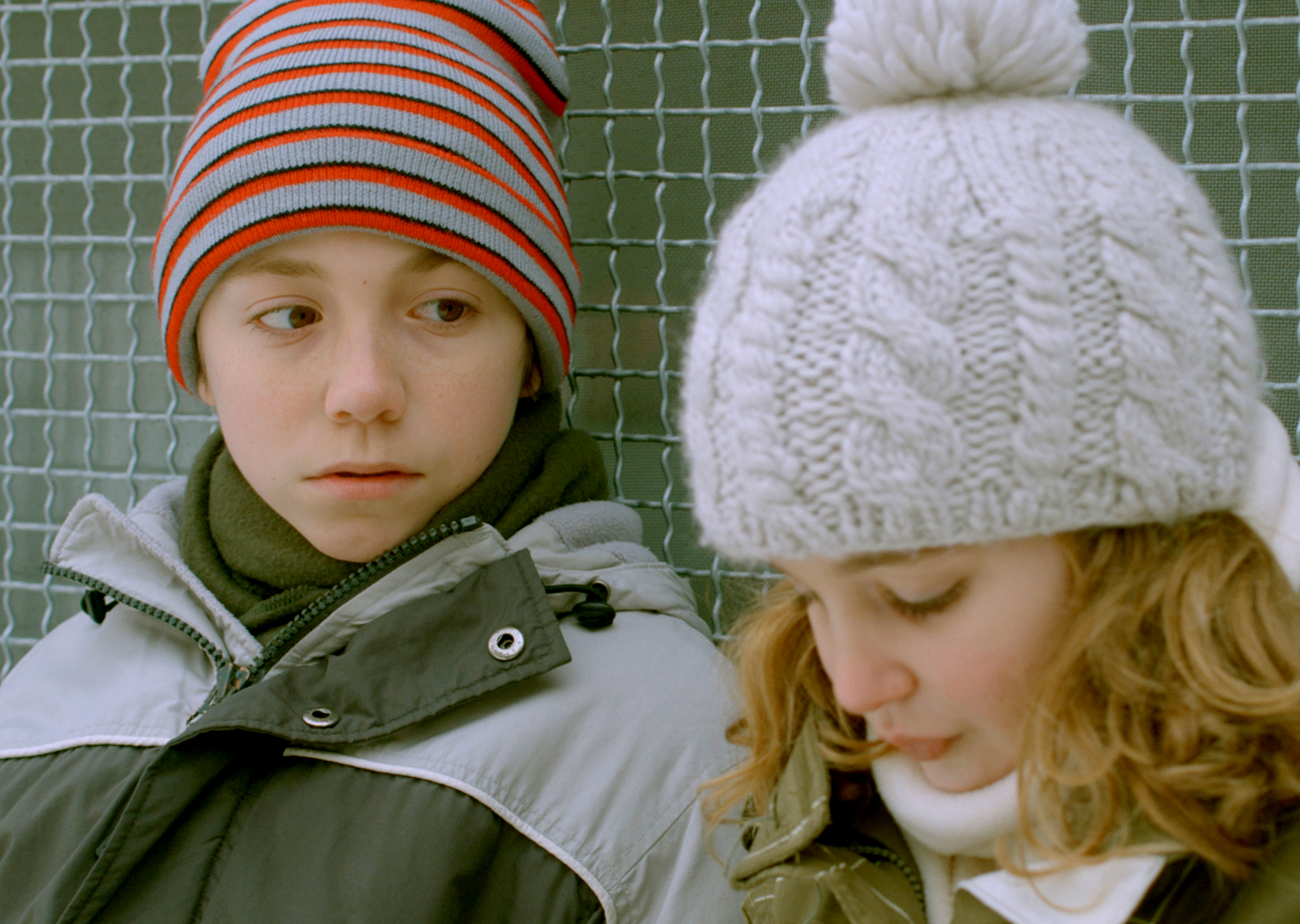
A compelling thread in the film surrounds loss and grief. After the class's teacher hangs herself in her own classroom, the administrative response is to move past it quickly, having the room painted a new color and using the school psychologist to "cure" the students. No one wants to talk about the suicide and why it happened, save for the children, who are disturbed by it in various complicated ways--none more than the two children who saw their teacher's dead body: Claire and Simon (Sophie Nélisse and Émilien Néron). Lazhar, recognizing this, defies the administration and provincial parents to give his students an outlet for honest communication. In a society obsessed with "closure" and neat endings, it was refreshing to see a film challenge such notions head on.
Fellage is the movie's anchor, though Sophie Nélisse and Émilien Néron are perhaps the true stars here, giving the kind of unaffected performances that only children can. The cathartic resolution of their conflict is a gut-wrenching moment in the film, instantly relatable to anyone who has tortured himself with secret guilt for too long.
The score features original compositions by Martin Léon, as well as lovely performances of Mozart's famous A-Major Piano Sonata and Scarlatti, all of which lovingly imbue "la belle province."
Monsieur Lazhar is a terrific film, easily better than that piece of cotton-candy, The Artist. In watching it I felt grateful that films like this are finding the light of day, and was reminded of how much I care about good, thoughtful art--and that's something that I hadn't felt in a long time at the movie theatres.